
| Kumaon Bladderwort |

|
 |

|


 |
 ative ative |
 |
 |
 |
Photo: |
Botanical name: Utricularia kumaonensis Family: Lentibulariaceae (Bladderwort family)
Synonyms: Diurospermum album
Synonyms: Diurospermum album
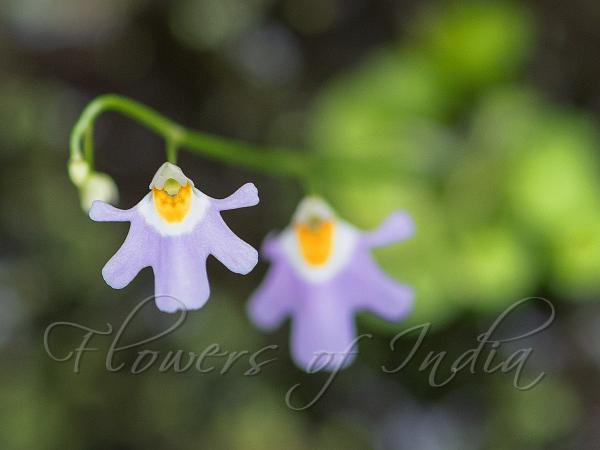
Kumaon bladderwort is an annual, tree-dwelling,
rock-dwelling or terrestrial, carnivorous herb. Flowers are white, with
a basal yellow spot and mauve lobes on lower lip, 3-5 mm; lower lip
nearly round, 5-lobed, middle lobe much larger than lateral lobes; spur
broadly cylindric, as long as upper sepal, slightly curved, tip blunt.
Upper lip is almost quadrate, about 1/2 as long as upper sepal, tip
flat to obscurely 2-lobed. Sepal-cup lower lobe oblong, much smaller
than upper lobe, tip flat and notched to erose; upper lobe
inverted-heart-shaped, about 2 mm, base rounded, tip deeply 2-parted.
Flowers are borne in erect, 2-7 cm, 1-3-flowered, hairless cluster atop
0.2-0.3 mm thick stem. Flower-stalks are erect at anthesis but decurved
in fruit, round, 2-6 mm, thread-like. Leaves are few, in a rosette at
stem base, stalked, hairless; leaf blade broadly obovate, round, or
kidney-shaped, 2-6 x 1.5-3 mm, membranous, veins symmetrically
branched, base broadly wedge-shaped, margin entire, tip rounded.
Capsules are obliquely ovoid, 2-2.5 mm. Kumaon bladderwort is is found
among moss on rocks, cliffs, fallen trees, at altitudes of 2600-2700 m,
from Himalayas to NW Yunnan and Myanmar. Flowering: July-August.
| Identification credit: Morten Ross | Photographed in Sikkim. |
• Is this flower misidentified? If yes,